

The basic idea of a stove guard, sometimes also called a cooker safety device, has been around for decades: cut the power to the stove if it is left on. However, the latest stove guards are already much more reliable in practice than earlier models, and they are also less obtrusive in everyday use. Development has taken place both in sensor technology and in the design of stove guards.
Despite this development, a stove guard is still very easy for the user, meaning the resident, to use. Below are answers to the questions we are most often asked about stove guards.
How is a stove guard installed?
Installing a stove guard on your existing stove is easy. Safera stove guards are compatible with all electric stoves up to 90 cm wide, including induction stoves. Safera Sense stove guards are also suitable for gas stoves.
A stove guard has two parts: a sensor unit, which monitors the status of the stove, and a power control unit, which controls the stove's power supply. The connection between them works wirelessly.
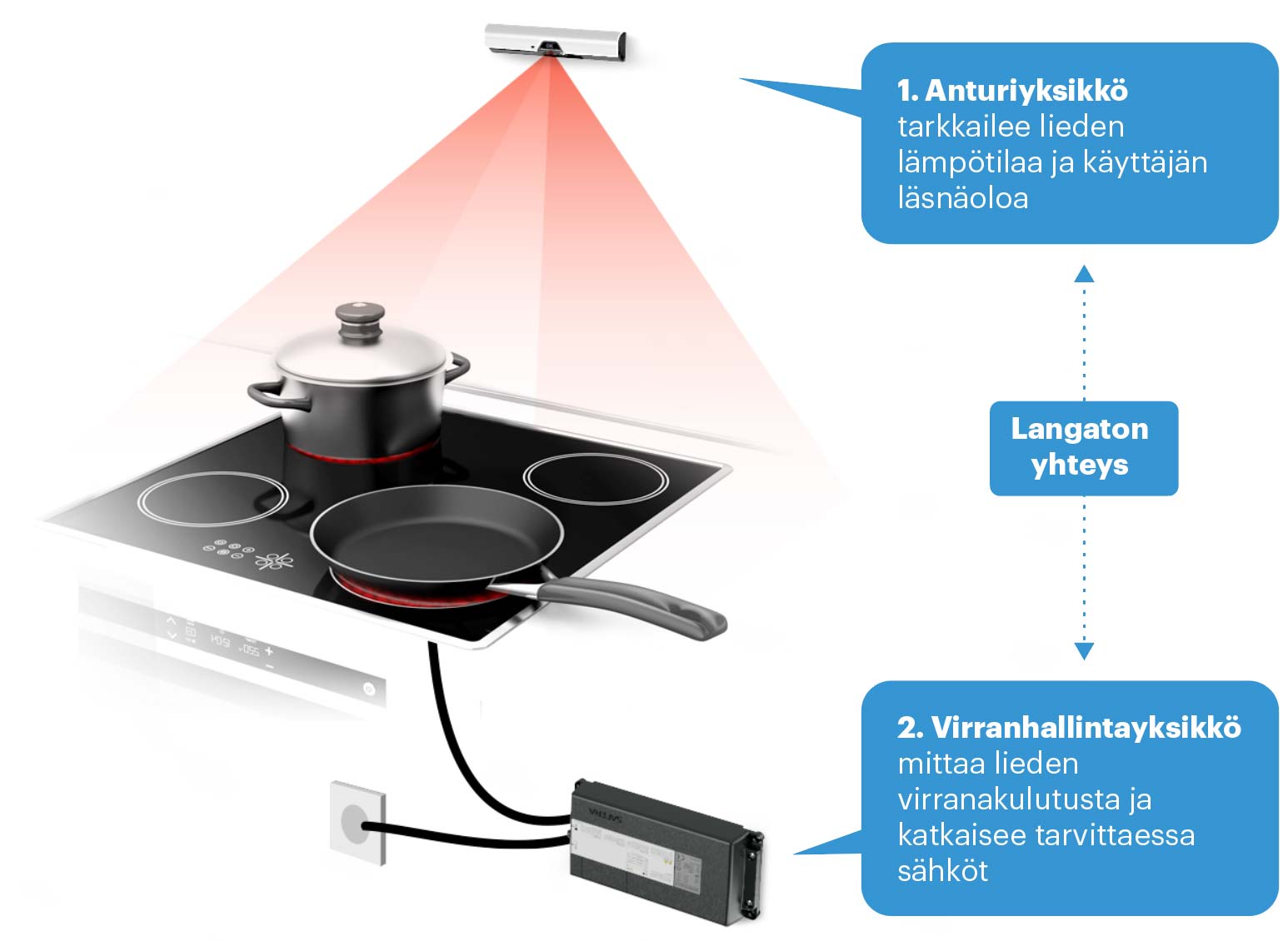
Sensor unit installation
The sensor unit is battery-powered. It is easy to install with a self-adhesive pad either on the wall or on the underside of the cooker hood.
The sensor unit is usually installed about 50 cm above the stove. Depending on the stove guard model , the permitted installation height can be 45–90 cm. There is also a model, Safera Aurora , which can be installed on the kitchen ceiling at a height of up to 3.5 metres.
Power control unit installation
The power control unit is connected to the stove's power supply. It is usually installed in the base cabinet behind or next to the stove.
The right power control unit model is selected based on the stove's electrical connection. Installing the power control unit usually requires an electrician. If the stove is connected with a plug, the unit can also be installed by the user.
The video below shows how a stove guard is installed.
How does a stove guard work?
A stove guard aims to prevent hazardous situations involving the stove before they occur. As long as cooking is safe, the stove guard does nothing except monitor how the stove is being used. If the stove guard detects a dangerous situation, it sounds an alarm and cuts the power to the stove.
The user can restore power to the stove by pressing the OK button on the sensor unit.
Safera stove guard monitors:
- Stove temperature
- Stove power consumption
- The presence of the user, in other words the person cooking
Safera prevents stove fires:
- Requires no action from the user
- Sounds an alarm only when a dangerous situation is about to occur
- Cuts power to the stove in a dangerous situation
- Does not interfere with cooking
When does a stove guard sound an alarm?
A stove guard sounds an alarm if a dangerous situation develops on the stove. Usually, the danger is caused by the stove being left on or left unattended for too long.
If the stove is on high power, the alarm may sound within a few minutes. If the stove is left on at a low setting, it may take longer.
The stove guard does not interfere with normal cooking. Instead, it takes into account how the stove is being used. Among other things, the alarm is affected by how high the stove power is and when a person was last near the stove.
Is a stove guard suitable for older people?
A stove guard can be installed on an existing stove that is already familiar to the user. It does not require learning how to use a new appliance. That is why it is also very suitable for older people.
Read more here about the benefits of a stove guard for older people.