
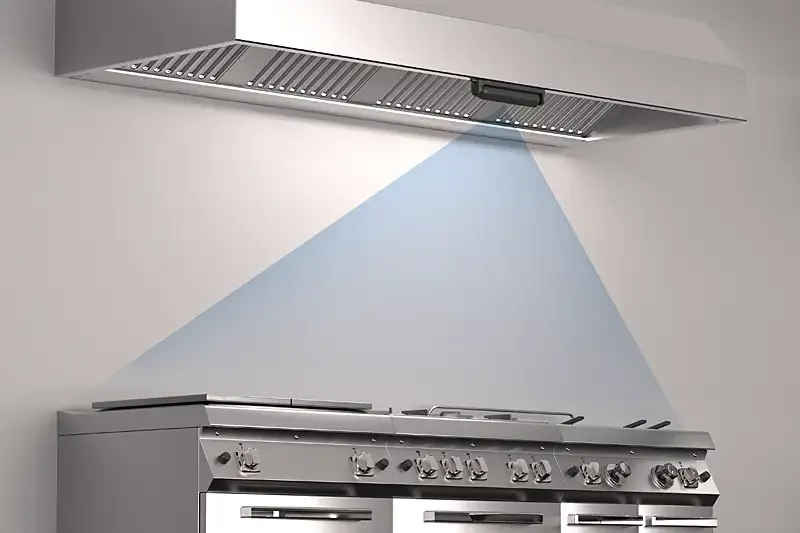
Restaurant kitchen ventilation should not simply be turned down permanently. The need for ventilation in a commercial kitchen varies through the day depending on what is happening in the kitchen.
If ventilation runs unnecessarily outside kitchen operating hours, energy use can be cut simply by changing the timer schedule. Kitchen load also changes during the day in ways that are hard to predict based on the time of day alone. Demand control solves this by adjusting ventilation automatically according to the kitchen’s actual situation.
Why should you not just turn ventilation down?
Commercial kitchen ventilation is sized for peak cooking load. If fan output or exhaust air volume is reduced permanently, ventilation may not be enough when several appliances run at once and a lot of heat, steam, and cooking fumes are produced.
On the other hand, design air volume is usually not needed all day. Load can vary considerably between prep, the lunch rush, and quieter periods.
A fixed air volume is therefore a compromise: it must be enough during peak load even when that volume is not needed for much of the day.
What can timer control save?
With a timer schedule, ventilation can be reduced when need can be predicted from the time of day. Ventilation can be stopped when the kitchen is closed, or run at a preset partial output when load is known to be lower.
Timer control still does not know what is actually happening in the kitchen. Load can vary within the same day and the same clock time depending on customer numbers, the menu, and which appliances are in use.
Timer control can therefore cut predictable unnecessary ventilation. Changes in load during the day require control that responds to the kitchen’s real situation.
How does demand control reduce air volume?
Demand control is based on the kitchen’s actual situation and adjusts ventilation in real time, automatically, as needed.
FlowHero adjusts air volume steplessly between minimum and design air volume. When kitchen load rises, air volume rises. When load falls, air volume falls. Ventilation can also be stopped and started automatically when needed.
Building maintenance does not need to estimate a suitable weekly schedule or what output ventilation should run at different times.
When exhaust air volume falls, less make-up air is needed. Less energy is then used to heat and cool supply air, and fan electricity consumption falls.
Read also: