
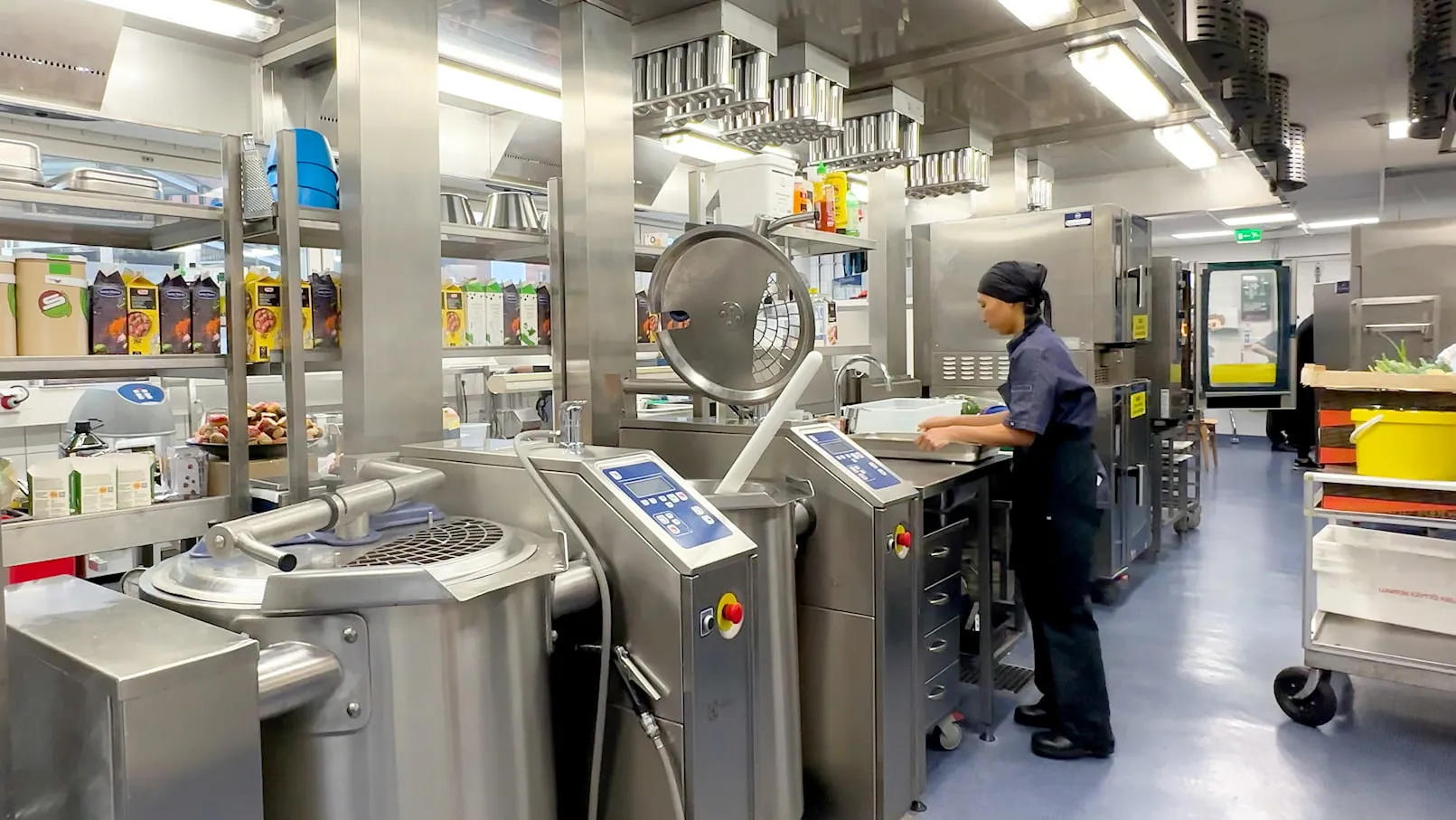
Commercial kitchen ventilation can be one of a property’s major energy users. Large volumes of air are removed from commercial kitchens, often thousands of litres per second.
Ventilation energy use depends especially on air volume, operating hours, outdoor temperature, possible heat recovery, and how ventilation is controlled. In a typical kitchen with 3–6 hoods, ventilation energy use is often in the range of about 45,000–90,000 kWh per year.
You can estimate current consumption and saving potential with our energy savings calculator, or we can calculate it for you. Read more: FlowHero energy savings calculator.
Why does restaurant ventilation matter for the whole property?
Many commercial kitchens operate as part of a larger property. A typical example is a staff restaurant in an office building.
Energy use per square metre in restaurants is many times higher than in other commercial space. That is why the restaurant—and especially its ventilation—can be a significant saving target when reducing energy use for the whole property.
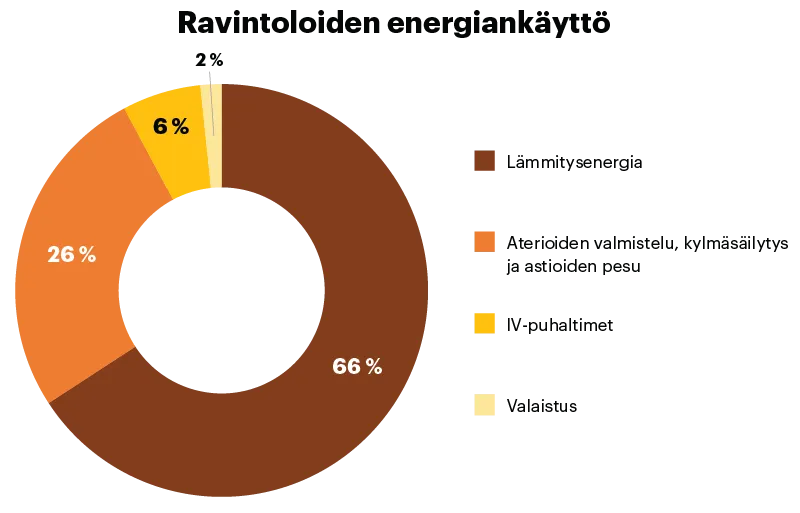
According to Motiva, ventilation and heating account for about 72% of restaurants’ total energy consumption.
How large is the air volume in a commercial kitchen?
Exhaust air volume from a single commercial kitchen hood is often around 300 litres per second. In a typical six-hood kitchen, exhaust air volume can be around 1,800 litres per second, and in large production kitchens several thousand litres per second.
Actual air volume for a site is confirmed from ventilation drawings or the building management system.
As a rule of thumb, ventilation for one hood can mean about 15,000 kWh of annual energy use. For a three- to six-hood kitchen the range is therefore about 45,000–90,000 kWh per year. A more precise calculation can be done per site with a few inputs.
Where does energy go in commercial kitchen ventilation?
Large volumes of air are removed from the commercial kitchen and an equal volume of make-up air is needed. Energy is used to heat supply air and, when needed, to cool it. Electricity is also used to run supply and exhaust fans.
The larger the air volume and the longer the operating time, the more energy ventilation uses.
That is also where saving potential comes from: when air is not removed from the kitchen unnecessarily, less make-up air is needed. Less energy is then used to heat and cool supply air and to run fans.
Does heat recovery remove saving potential?
No. Heat recovery reduces the energy needed to heat supply air, but air volume, operating hours, and how ventilation is controlled still affect energy use.
The more air is exhausted, the more make-up air is needed and the more energy is used to heat or cool air and run fans. Demand control kitchen ventilation can therefore also save energy at sites with heat recovery.
Read also: Heat recovery or demand control for commercial kitchen ventilation – or both?
Why does timer control not always minimise energy use?
With timer control, building maintenance sets in advance the times when ventilation runs. Actual kitchen load still varies through the day.
A restaurant may be open for ten hours, but full design air volume is not needed all that time. Sometimes the kitchen is in prep and sometimes several appliances run at full power at once. Menus, opening hours, and kitchen use can also change.
With demand control, building maintenance does not need to estimate suitable operating times and air volumes in advance. Ventilation adjusts in real time, automatically, according to the kitchen’s actual situation.
Read also: Timer control or demand control for commercial kitchen ventilation?
How much can demand control save?
Savings depend on how ventilation operated before demand control was introduced. The greatest potential is usually in sites where large air volumes run for long periods regardless of actual kitchen load.
For example, at Areim’s Aallonharja realised energy savings in the first year of operation were 190.7 MWh. At Turun Teknologiakiinteistöt’s Kupittaa Pavilion annual energy savings were calculated at 69.5 MWh.
Realised savings can be calculated from fan control data. Control data can come from data collected by FlowHero or from building automation trend data.
Read also: How to verify energy savings from demand control kitchen ventilation?
Find your property’s saving potential
Energy use and saving potential for commercial kitchen ventilation can be estimated with a few inputs. You need current air volumes, ventilation operating hours, information on possible heat recovery, and the property’s heating and electricity costs.
You can make a preliminary estimate yourself with the FlowHero energy savings calculator or ask us for a free site-specific savings calculation.
Calculate saving potential · Request a free savings calculation